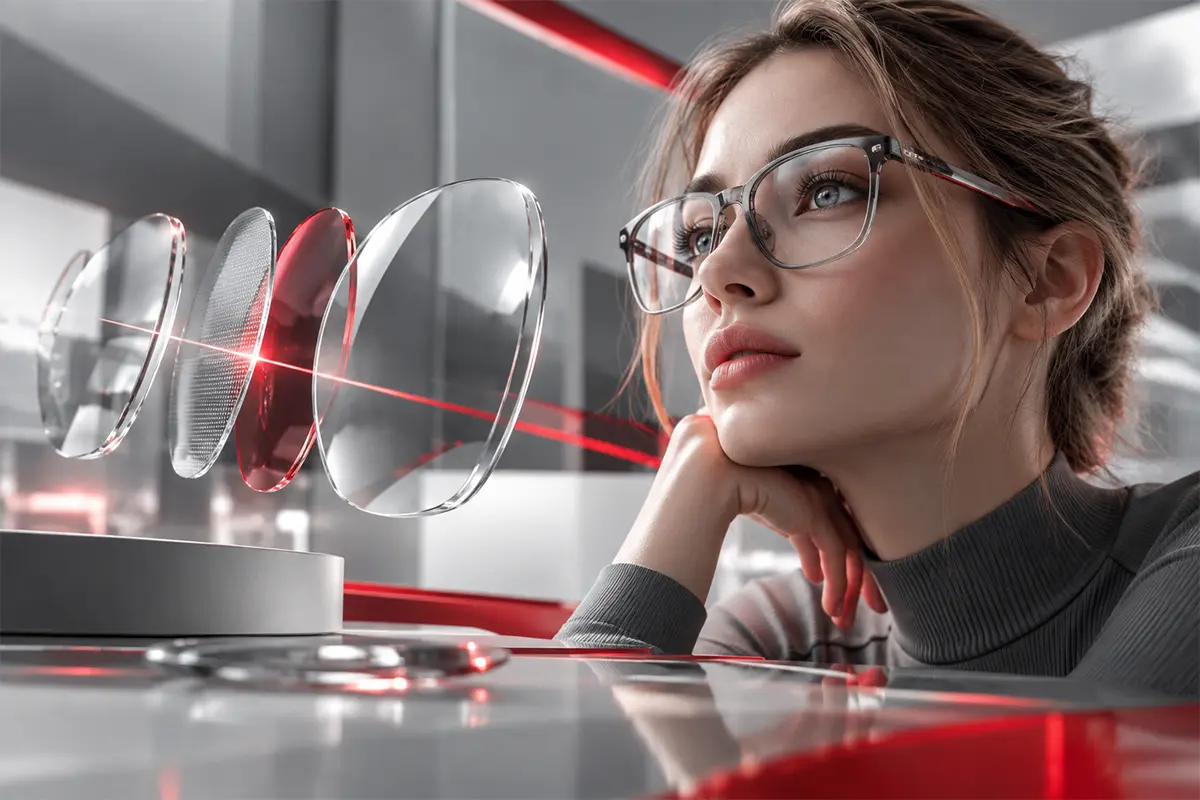
Smart Optical Lenses: The Next Generation of Eyewear Technology
Eyeglasses have changed dramatically over the past century.
What was once a simple combination of a frame and a corrective lens has evolved into a highly engineered optical product, with
awide range of modern eyeglass lens options designed for different visual needs.
But what comes next?
The future of optical lenses is moving toward greater personalization, digital integration, smarter materials, and new ways of interacting with the visual environment.
From smart eyewear technology to self-adjusting lenses and AR glasses lenses, the next generation of eyewear could look very different from the glasses we wear today.
How Will Eyeglasses Change in the Future?
The basic purpose of eyeglasses will remain the same: helping people see clearly.
However, the way lenses achieve this goal is likely to become increasingly sophisticated.
Future lens development is expected to focus on several major areas:
Greater personalization
Digital optical design
Adaptive optical functions
Integration with electronic devices
Augmented reality
Advanced lens materials
Improved protection and visual comfort
Instead of thinking of glasses as a passive optical device, we may increasingly see them as part of a connected visual technology system.
The Rise of Smart Eyewear Technology
One of the most important trends in eyewear is the development of smart eyewear technology.
Smart glasses combine traditional eyewear with electronic components such as cameras, sensors, microphones, speakers, processors, and wireless connectivity.
The lens itself can also become part of this technological ecosystem.
Rather than simply correcting vision, future eyewear could potentially provide information directly within the wearer's field of view.
This could include navigation information, notifications, translations, environmental information, or other digital content.
The goal is not necessarily to replace smartphones completely, but to make digital information available in a more natural visual format.
As an optical lens and eyewear distributor, staying connected to these technological developments is becoming increasingly important as the industry moves toward smarter and more integrated vision solutions.
What Are AR Glasses Lenses?
AR glasses lenses are designed for augmented reality applications.
Unlike conventional prescription lenses, AR-compatible lenses may need to work alongside optical and electronic systems that place digital information within the user's visual environment.
This creates completely new engineering challenges.
The lens must remain optically useful while accommodating technologies such as:
Micro-displays
Optical waveguides
Sensors
Cameras
Light-management systems
Electronic components
In some future products, prescription correction and digital information may need to coexist within the same optical system.
This means the future of lens technology will increasingly involve collaboration between traditional optics, electronics, software, and materials science.
Could Lenses Adjust Themselves?
One of the most interesting concepts in the future of optical lenses is the self-adjusting lens.
Today, most prescription lenses have a fixed optical power.
If your prescription changes, the lens needs to be replaced.
A self-adjusting lens, in contrast, would theoretically be capable of changing its optical characteristics according to the user's visual requirements.
Several approaches to adaptive optics are being researched and developed, including systems that could potentially change optical power electronically or mechanically.
Future applications could include lenses that respond to:
Viewing distance
Lighting conditions
User requirements
Different visual tasks
Changes in prescription
However, self-adjusting prescription lenses are still an emerging area of technology. The technology needs to address challenges such as power consumption, size, reliability, optical quality, cost, and everyday usability before it can become a mainstream solution.
So while the concept is promising, consumers should distinguish between current products and technologies that are still under development.
Personalized Lenses Will Become More Advanced
Personalization is already one of the major trends in modern optical lenses.
Digital freeform technology has made it possible to design increasingly sophisticated lens surfaces based on the wearer's prescription and, depending on the lens product, additional fitting and usage parameters.
The future is likely to take this personalization further.
Instead of producing a lens primarily around prescription power, future systems may consider a wider range of information about how an individual actually uses their glasses.
For example:
Typical working distances
Digital device usage
Driving requirements
Reading habits
Frame geometry
Visual preferences
Age-related visual changes
This could lead to lenses that are increasingly designed around the individual rather than around a standardized prescription.
Artificial Intelligence and the Future of Lens Design
Artificial intelligence is also likely to influence optical lens development.
AI can process large amounts of information and identify patterns that may be difficult to evaluate using conventional approaches.
In the future, AI could potentially assist with:
Lens design optimization
Prescription analysis
Frame and lens matching
Personalized visual solutions
Manufacturing quality control
Predictive maintenance in optical production
The role of AI will not necessarily be to replace optical professionals.
Instead, AI can become another tool that helps designers, manufacturers, opticians, optometrists, and other professionals make better-informed decisions.
The human expertise behind prescription, fitting, patient communication, and clinical decision-making will remain important.
New Lens Materials for Future Eyewear
Materials are another important part of the future of optical lenses.
Modern lens materials already provide combinations of:
Lightweight construction
Impact resistance
UV protection
High refractive index
Improved optical performance
Future materials may be developed to provide additional functionality while remaining lightweight, durable, and optically suitable.
The challenge is significant.
A lens material must not only provide a useful optical function. It also needs to meet practical requirements such as durability, transparency, manufacturability, weight, cost, and long-term stability.
For this reason, material innovation will likely develop alongside advances in lens design and manufacturing.
Will Future Glasses Still Look Like Glasses?
One of the most interesting questions is: What will glasses look like in the future?
The answer is not yet clear.
Some future products may look remarkably similar to conventional glasses, with technology integrated discreetly into the frame.
Others may look more like electronic wearables.
The most successful designs will likely have to balance technology with comfort, appearance, battery life, weight, and everyday usability.
After all, consumers still need to wear their glasses for hours every day.
A product with impressive technology will have limited value if it is uncomfortable, too heavy, difficult to use, or visually unattractive.
The Future of Progressive and Prescription Lenses
Traditional prescription lenses are also likely to benefit from future technology.
Progressive lenses, for example, could become increasingly personalized as digital design systems become more sophisticated.
Future lens designs may potentially optimize different visual zones according to individual activities and preferences.
A person who spends most of the day working at a computer may have different visual requirements from someone who drives extensively or spends much of the day outdoors.
This could make the concept of a "standard" lens less important over time.
Instead, lenses may become increasingly tailored to the user's daily visual environment.
Smart Coatings and Optical Protection
The future of lenses is not only about the optical surface.
Coating technology is also continuing to evolve.
Anti-reflective coatings, scratch-resistant treatments, UV protection, and specialized optical filters already play an important role in modern eyewear.
Future coatings may focus on improving durability, optical clarity, resistance to environmental conditions, and compatibility with emerging digital eyewear technologies.
For smart glasses and AR applications, controlling unwanted reflections and managing light transmission can become particularly important.
This means coating technology may become an increasingly important part of the overall optical system.
What Will the Future of Optical Lenses Look Like?
The future is unlikely to be defined by a single revolutionary lens.
Instead, it will probably be shaped by the combination of several technologies:
Digital design + advanced materials + smart electronics + personalization + adaptive optics
Some of these technologies are already available today.
Others are still being developed and tested.
The transition will likely happen gradually, with new technologies first appearing in specialized applications before becoming more accessible to everyday consumers.
Schneider and the Future of Optical Lenses
At Schneider, the future of eyewear begins with the development of modern optical solutions designed around changing visual needs.
Digital lens technology, advanced optical design, modern materials, and specialized lens functions are already changing the way prescription lenses are developed and manufactured.
As eyewear continues to evolve, the distinction between a traditional optical product and a smart visual device may become increasingly smaller.
Schneider's focus on modern lens technology provides a foundation for participating in this evolution—from advanced prescription lenses available today to the broader possibilities that future optical technologies may bring.
Final Thoughts
The future of optical lenses is not simply about making lenses thinner or stronger.
It is about making them smarter, more personalized, and better adapted to the way people actually use their vision.
Smart eyewear technology, AR glasses lenses, adaptive optical systems, advanced materials, AI-assisted design, and increasingly personalized freeform lenses are all contributing to this transformation.
Some technologies, such as digital freeform lens design, are already part of modern optical manufacturing. Others, including fully self-adjusting prescription lenses, are still developing.
What is clear is that the next generation of eyewear will continue to combine optical science with digital technology.
And as these technologies mature, the glasses of tomorrow may become much more than something we wear to see clearly—they may become an intelligent part of how we interact with the world around us.