What is a Progressive Lens? Everything You Need to Know
Categories: Posts Date: 11/06/2026 Author: AdminWhat Is a Progressive Lens?
If you've recently started holding books farther away, struggling to read your smartphone, or switching between multiple pairs of glasses throughout the day, you've probably heard about progressive lenses.
But what exactly are progressive lenses, and why have they become one of the most popular vision solutions for adults?
In simple terms, progressive lenses are multifocal lenses that provide clear vision at multiple distances without the visible lines found in traditional bifocal or trifocal lenses. If you want to understand them better in the context of different lens options, a guide to prescription lenses can help you see how they compare with other types and why they are often recommended for everyday use.
They allow wearers to see clearly when:
- Looking far away
- Using a computer
- Reading books or smartphones
all through a single pair of glasses.
In this guide, we'll explain how progressive lenses work, who can benefit from them, and why modern lens technology has made them more comfortable than ever before.

Why Do People Need Progressive Lenses?
As we age, the eye gradually loses its ability to focus on nearby objects.
This natural condition is called presbyopia.
Most people begin noticing symptoms in their early to mid-40s, including:
- Difficulty reading small print
- Holding reading materials farther away
- Eye strain during close work
- Frequent switching between distance and reading glasses
Progressive lenses were developed to solve these challenges by combining multiple prescriptions into a single lens.
How Progressive Lenses Work
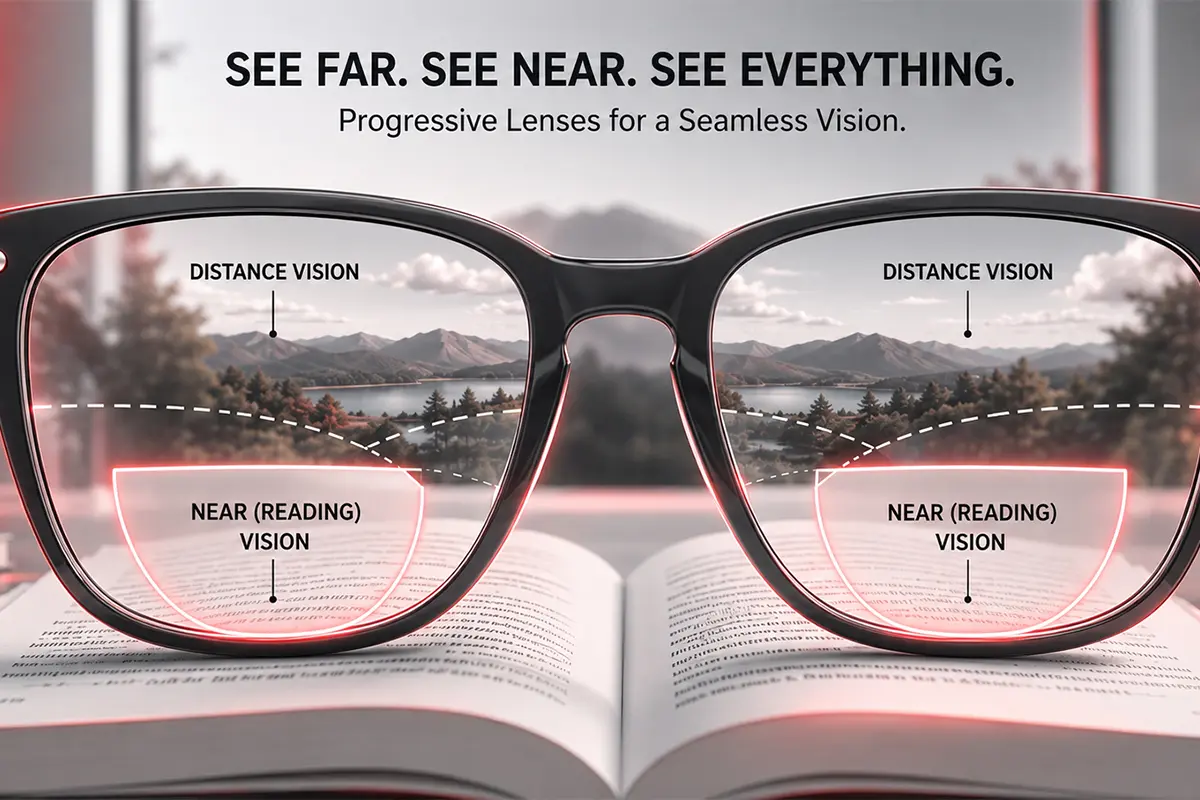
Unlike single vision lenses, which contain one prescription power throughout the entire lens, progressive lenses gradually change power from top to bottom.
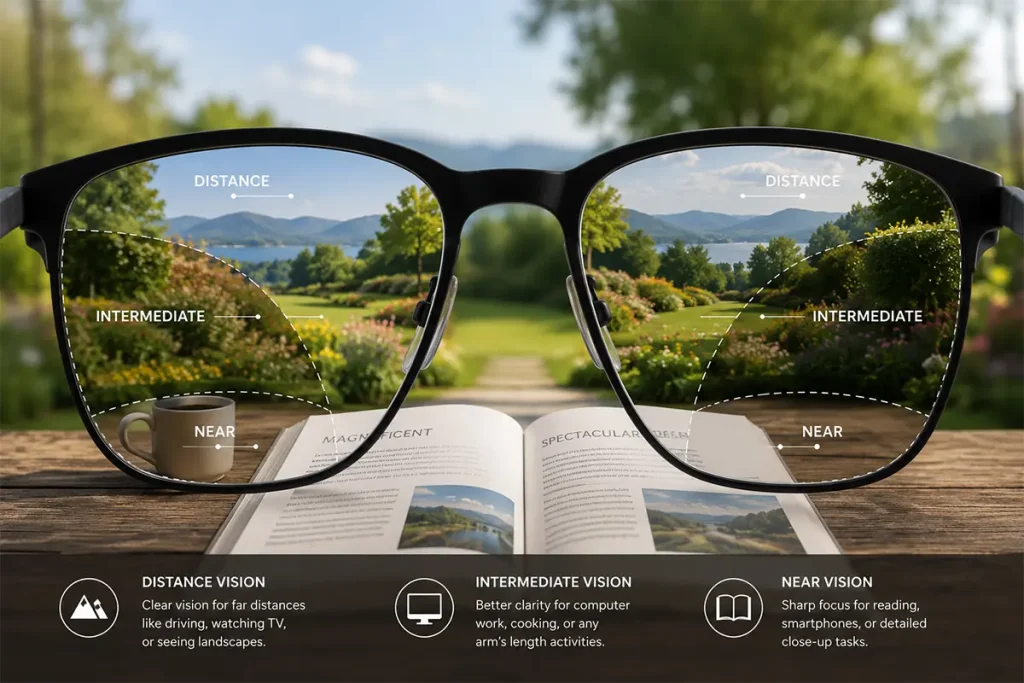
A typical progressive lens contains three main visual zones:
Distance Zone
Located in the upper portion of the lens.
Used for:
- Driving
- Watching television
- Walking outdoors
- General distance vision
Intermediate Zone
Located in the middle of the lens.
Used for:
- Computer work
- Viewing dashboards
- Shopping
- Everyday tasks
Near Vision Zone
Located in the lower portion of the lens.
Used for:
- Reading
- Smartphones
- Tablets
- Detailed close-up work
The transition between these zones is smooth and invisible.
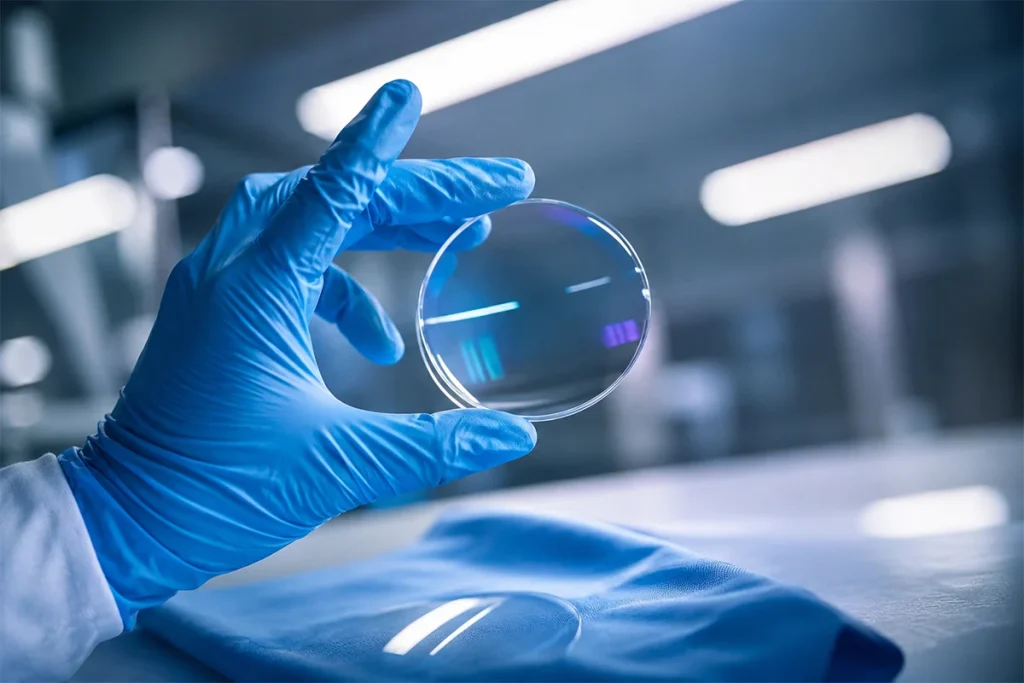
Caption: Progressive lenses provide seamless vision correction for near, intermediate, and distance viewing.
Progressive Lenses vs Bifocal Lenses
Before progressive lenses became common, bifocal lenses were the standard solution for presbyopia.
Bifocals contain two separate prescription areas divided by a visible line.
Progressive lenses offer several advantages:
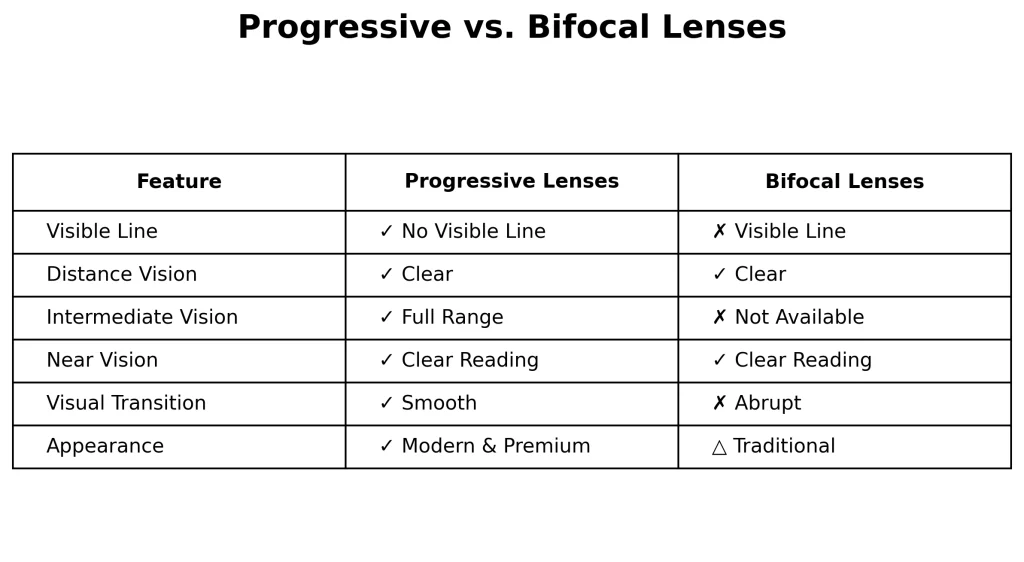
For many wearers, progressive lenses provide a more natural visual experience and a more attractive appearance.
Benefits of Progressive Lenses
One Pair for Multiple Activities
One of the biggest advantages of progressive lenses is convenience.
Instead of carrying separate glasses for:
- Reading
- Computer use
- Distance vision
users can rely on one pair throughout the day.
Natural Vision Transitions
Because the prescription changes gradually, wearers can shift focus naturally between different distances.
This makes everyday activities more comfortable.
Modern Appearance
Unlike bifocals, progressive lenses have no visible segments or lines.
To others, they look like standard eyeglass lenses.
Improved Daily Comfort
Many people appreciate the freedom of moving between reading, driving, and computer work without constantly changing glasses.

Do Progressive Lenses Require an Adjustment Period?
Yes.
Most first-time wearers experience a short adaptation period while learning how to use different parts of the lens.
Common experiences include:
- Slight peripheral blur
- Learning new head movements
- Adjusting reading posture
Most users adapt within a few days to a few weeks.
Modern lens designs have significantly improved adaptation compared to earlier generations of progressive lenses.
Are Progressive Lenses Right for Everyone?
Progressive lenses are ideal for many adults, particularly those with presbyopia.
They are often recommended for people who:
- Need both distance and near correction
- Use computers regularly
- Want to avoid carrying multiple pairs of glasses
- Prefer a line-free lens appearance
However, some users may still prefer specialized reading glasses for extended close work.
The best choice depends on individual visual needs and lifestyle.
What Makes Modern Progressive Lenses Different?
Today's progressive lenses are far more advanced than those introduced decades ago.
Modern manufacturing technologies and innovations in materials used in eyeglass lenses enable:
Wider viewing zones
Better peripheral vision
Reduced distortion
Faster adaptation
Personalized lens optimization
These improvements have transformed progressive lenses into one of the most sophisticated products in modern eyewear.
Modern Digital Progressive Lens Technology
The Role of Advanced Manufacturing in Progressive Lenses
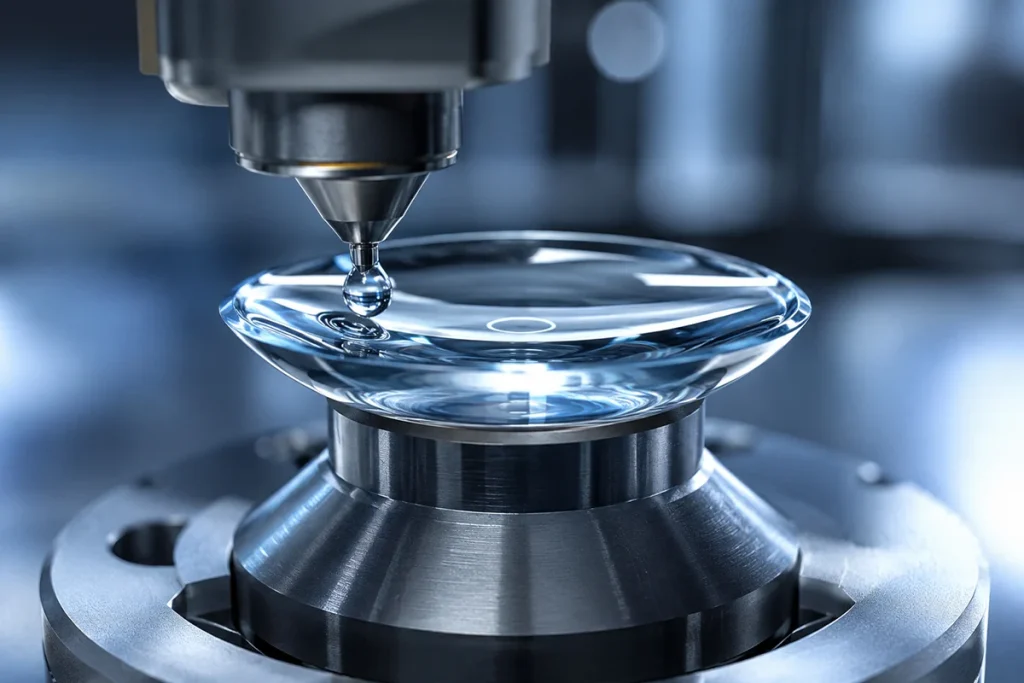
The performance of a progressive lens depends not only on its design but also on how precisely it is manufactured.
Modern freeform production technologies allow laboratories to create highly accurate lens surfaces customized for individual prescriptions.
This level of precision helps improve:
- Visual clarity
- Comfort
- Adaptation
- Overall wearer satisfaction
Companies such as Schneider Optical Machines have contributed significantly to the advancement of digital lens manufacturing technologies used by optical laboratories worldwide.
Discover Schneider Progressive Lens Technology
Modern progressive lenses require extraordinary precision during design and manufacturing.
Through advanced technologies for freeform surfacing, polishing, and digital lens production, Schneider Optical Machines helps optical laboratories produce high-performance lenses that deliver greater comfort and visual accuracy.
Why Advanced Manufacturing Matters
- Improved progressive lens performance
- Enhanced wearer comfort
- More accurate vision correction
- Better adaptation experience
- Consistent optical quality
As lens technology continues to evolve, precision manufacturing remains one of the key factors behind successful progressive lens performance.
Final Thoughts
Progressive lenses offer a practical and elegant solution for people who need clear vision at multiple distances.
By combining distance, intermediate, and near correction into one lens, they eliminate the need for multiple pairs of glasses while maintaining a clean, modern appearance.
Thanks to advances in digital lens design and manufacturing, today's progressive lenses provide better comfort, wider viewing areas, and improved visual experiences than ever before.
For Schneider's audience, this article is intentionally focused not only on the consumer benefits of progressive lenses but also on the manufacturing precision and freeform technology behind them, which aligns well with Schneider's positioning in the optical industry.