High Index Lenses: A Complete Guide to Thin Lenses for Strong Prescriptions
Categories: Posts Date: 28/09/2026 Author: AdminIf you have a strong eyeglass prescription, you may already know one of the biggest challenges of wearing glasses: thick and heavy lenses.
Higher prescriptions can require more optical material to provide the necessary vision correction. This can make conventional lenses thicker at the edges or center, depending on whether the prescription is for nearsightedness or farsightedness.
Fortunately, modern lens materials offer another option.
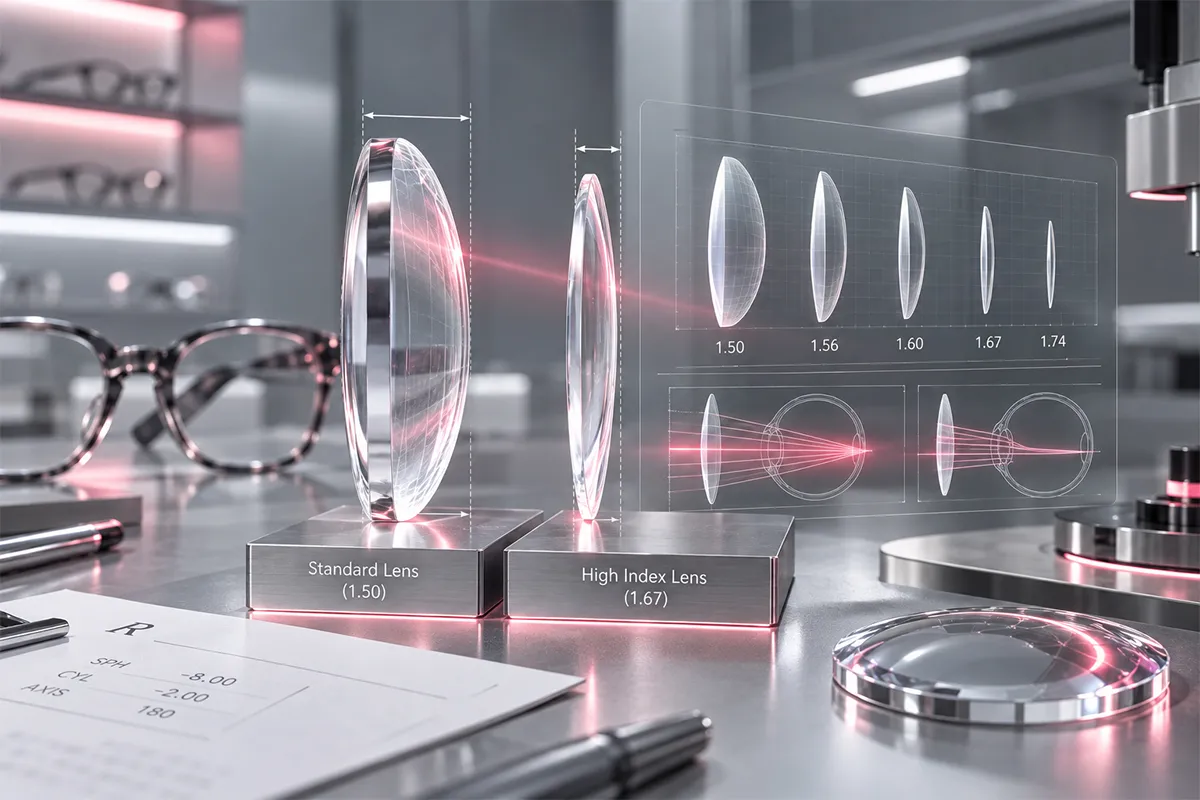
High index lenses are specifically designed to provide the required optical power while using less material. This allows manufacturers to produce thin lenses for strong prescriptions that can be lighter, more comfortable, and more attractive.
For people with stronger prescriptions, understanding materials such as 1.67 and 1.74 high index lenses can be an important part of a broader guide to prescription lens options and help make the process of choosing the right pair of glasses easier.


What Are High Index Lenses?
The term "index" refers to the refractive index of the lens material. A material with a higher refractive index can bend light more efficiently. Because of this, the lens does not need to be as thick to achieve the same optical power. For example, a strong prescription can often be made thinner using a 1.67 or 1.74 material than with a standard lower-index material. This is why high index lenses are commonly recommended for people who need strong prescription glasses. The basic principle is simple:Higher refractive index → less material needed → potentially thinner lens
However, the final thickness also depends on other factors, including the prescription, lens diameter, frame shape, and how the lens is fitted.Why Do Strong Prescriptions Need Thinner Lenses?
The thickness of an eyeglass lens is not determined by prescription power alone. For a person with significant myopia, conventional lenses may become relatively thick around the edges. For someone with significant hyperopia, the center of the lens may become noticeably thicker. This can affect:- Lens appearance
- Overall weight
- Frame selection
- Wearing comfort
- The appearance of the eyes through the lenses High index materials help address one of these challenges by allowing the required optical power to be produced with a thinner lens profile.
High Index 1.67 vs 1.74 Lenses: What's the Difference?
Two of the most commonly discussed high index materials are 1.67 and 1.74 lenses. Both are designed for people who want thinner lenses, particularly when prescription strength makes lens thickness more noticeable.
1.67 High Index Lenses
A 1.67 lens provides a significant reduction in thickness compared with many conventional lens materials. It can be a practical choice for moderate-to-strong prescriptions and can offer a good balance between:- Thinness
- Weight
- Optical performance
- Cost
1.74 High Index Lenses
A 1.74 lens has an even higher refractive index. This allows the lens to be made thinner, particularly when the prescription is very strong. For people looking for the thinnest possible lens for a strong prescription, 1.74 may be considered when the prescription and frame design justify it. However, choosing the highest index available is not automatically the best decision for every wearer.Which Is Better: 1.67 or 1.74?
The answer depends on the prescription and the desired result. A 1.74 lens can provide additional thickness reduction compared with 1.67, but the difference may not be equally noticeable for every prescription. For a moderate prescription, 1.67 may already provide an excellent balance. For a very strong prescription, the additional reduction offered by 1.74 can become more valuable. The right choice should therefore consider the complete optical system rather than the index number alone. Important factors include:- Prescription power
- Lens diameter
- Frame size
- Frame shape
- Pupillary distance
- Lens design
- Desired appearance
- Budget
Are High Index Lenses Lightweight?
One common misconception is that a thinner lens is automatically much lighter. The reality is more nuanced. High index materials allow a lens to be made thinner, which can reduce the amount of material used. However, the density of the material is also important when considering overall lens weight. Therefore, thinness and lightness are related but not identical. For strong prescriptions, a well-designed high index lens can still provide an important advantage in both appearance and wearing comfort. The final result depends on the combination of material, prescription, lens size, and design.Why Lens Design Matters as Much as Lens Material
Choosing a high index material is only one part of creating thin prescription glasses. The lens design can also influence the final thickness. A smaller frame, for example, generally allows less lens material to be required than a very large frame. The shape of the frame also matters. For a strong prescription, an optician may recommend a frame that allows the lens to be positioned and edged in a way that helps optimize thickness. This means that achieving thin lightweight glasses lenses is not simply a matter of choosing 1.74 material. It is a combination of:Material + Prescription + Lens Design + Frame + Fitting
High Index Lenses for Strong Myopia
High index materials are particularly useful for people with significant myopia (nearsightedness). In myopic prescriptions, especially when the degree of myopia is higher, lenses are generally thinner at the center and become progressively thicker toward the edges. As the level of myopia and prescription strength increases, this edge thickness can become more noticeable, affecting both the appearance and overall weight of the glasses. High index materials can help reduce this effect by providing the required vision correction with less lens material. However, lens material is only one part of managing eyewear for people with myopia. Frame selection also becomes especially important. A smaller frame with a shape that works well with the prescription can often help reduce visible edge thickness and create a more balanced result. For this reason, someone with a strong myopic prescription should ideally choose the lens and frame together rather than selecting the frame first and considering the lens afterward. For children whose myopia is still progressing, myopia control lenses may also be considered as part of a broader approach to managing myopia over time.High Index Lenses for Hyperopia
High index materials can also be useful for strong plus prescriptions. Unlike myopic lenses, plus lenses are typically thicker toward the center and thinner toward the edges. A high index material can reduce the central thickness of the lens while maintaining the required prescription power. This can improve the appearance of the finished glasses and potentially reduce the amount of material used. For people with significant hyperopia, lens design and frame selection remain important factors in achieving a balanced result.What Are the Benefits of High Index Lenses?
For people with stronger prescriptions, high index lenses can offer several practical advantages.Thinner appearance
The most obvious advantage is reduced lens thickness compared with lower-index materials.Better aesthetics
Thinner lenses can create a more streamlined appearance, particularly with strong prescriptions.More frame options
A thinner lens can make certain frame styles more practical for people with strong prescriptions.Potentially improved comfort
Reducing lens thickness and optimizing the overall lens design can contribute to a more comfortable pair of glasses.Suitable for modern lens designs
High index materials can be used in a variety of prescription lens designs, including single vision and progressive lenses, depending on the product specifications.Are High Index Lenses Right for Everyone?
Not necessarily. If your prescription is relatively low, moving to a very high index material may provide little practical benefit. In such cases, a standard material may offer an appropriate balance of optical performance, thickness, weight, and cost. High index materials become increasingly relevant as prescription strength increases. The best approach is to discuss the prescription and frame with an optical professional who can compare the available options.Schneider High Index Lenses
Schneider offers modern lens solutions designed to meet different prescription and lifestyle requirements. For consumers with stronger prescriptions, high index lens materials can provide an effective way to achieve a thinner and more refined lens profile. Depending on the prescription and lens design, options such as 1.67 and 1.74 high index lenses can help optimize the final appearance and performance of the glasses. Schneider's approach combines lens material selection with modern optical design and precision manufacturing, helping optical professionals provide a more appropriate lens solution for each prescription.
How to Choose the Best Lenses for Strong Prescription Glasses
If you have a strong prescription, don't choose your lens based on refractive index alone. Consider these questions with your optician:-
How strong is my prescription?
-
What frame am I going to wear?
-
Would 1.67 be sufficient?
-
Would 1.74 provide a meaningful advantage?
-
What coatings should I choose?