Understanding Eyeglass Lenses: Everything You Need to Know
Choosing the right eyeglass lenses is just as important as selecting the right frame. While frames affect comfort and style, lenses directly influence how clearly and comfortably you see every day. Modern lens technology and lens materials have advanced significantly, offering a wide range of solutions for different needs such as distance vision, reading, digital screen use, sports, driving, and myopia management.
In this complete eyeglass lenses guide, we will explain the different types of eyeglass lenses, how eyeglass lenses work, and how to choose the best prescription lenses for your lifestyle.
What Are Eyeglass Lenses?
Eyeglass lenses are optical devices designed to correct refractive errors and improve vision. They work by bending light before it enters the eye, helping the light focus correctly on the retina.
When the eye cannot naturally focus light properly, vision becomes blurry. Prescription lenses compensate for this problem by adjusting the path of incoming light.
The most common vision conditions corrected by eyeglass lenses include:
- Nearsightedness (Myopia)
- Farsightedness (Hyperopia)
- Astigmatism
- Presbyopia (age-related near vision difficulty)
Today’s modern prescription lenses can also include advanced features such as blue light protection, anti-reflective coatings, UV protection, and personalized digital lens designs.
How Eyeglass Lenses Work
To understand how eyeglass lenses work, it helps to understand how the human eye focuses light.
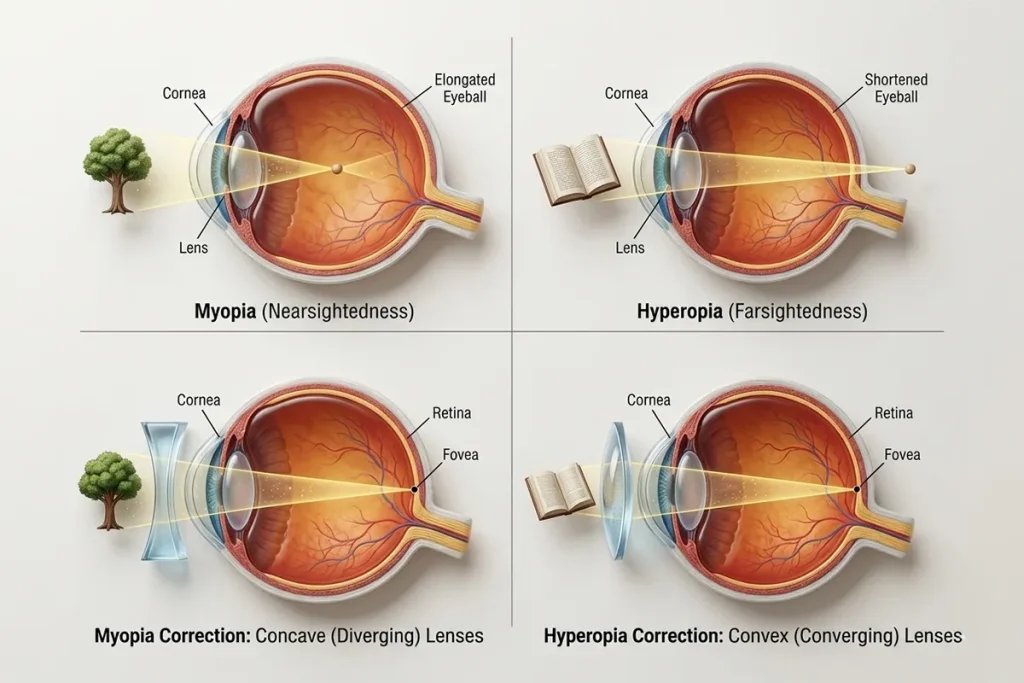
In a healthy eye, light rays pass through the cornea and lens and focus directly on the retina. However, if the eye shape is too long, too short, or irregular, the focus point shifts, causing blurry vision.
Eyeglass lenses correct this by altering the direction of light rays.
Concave Lenses for Myopia
People with myopia can see nearby objects clearly but struggle with distance vision. Concave lenses spread light outward slightly before it enters the eye, moving the focus point back onto the retina.
Convex Lenses for Hyperopia
Hyperopia makes nearby objects difficult to see clearly. Convex lenses bring light inward, helping the eye focus properly.
Cylindrical Correction for Astigmatism
Astigmatism occurs when the cornea has an uneven shape. Specialized lens designs compensate for these irregularities and improve visual sharpness.
Types of Eyeglass Lenses
Understanding the different types of eyeglass lenses helps consumers choose the best solution for their vision needs.
Single Vision Lenses
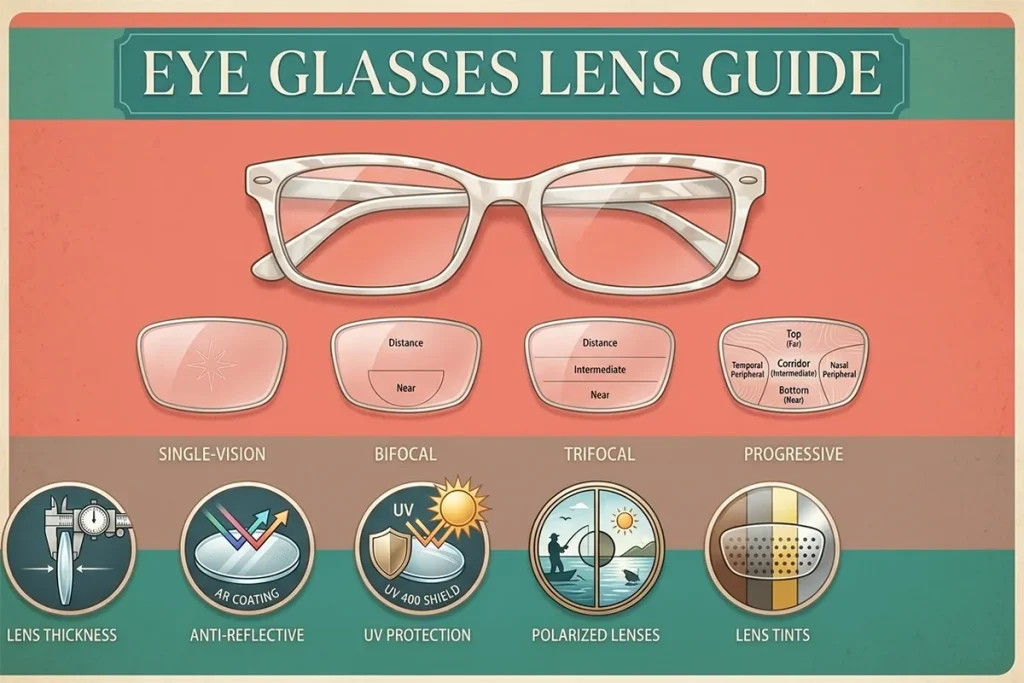
Single vision lenses are the most common type of prescription lenses. They provide one consistent prescription across the entire lens surface.
They are typically used for:
- Distance vision
- Reading
- Computer work
Single vision lenses are simple, effective, and suitable for many everyday vision needs.
Progressive Lenses
Progressive lenses provide multiple vision zones in one lens without visible lines. They allow smooth transitions between:
- Distance vision
- Intermediate vision
- Near vision
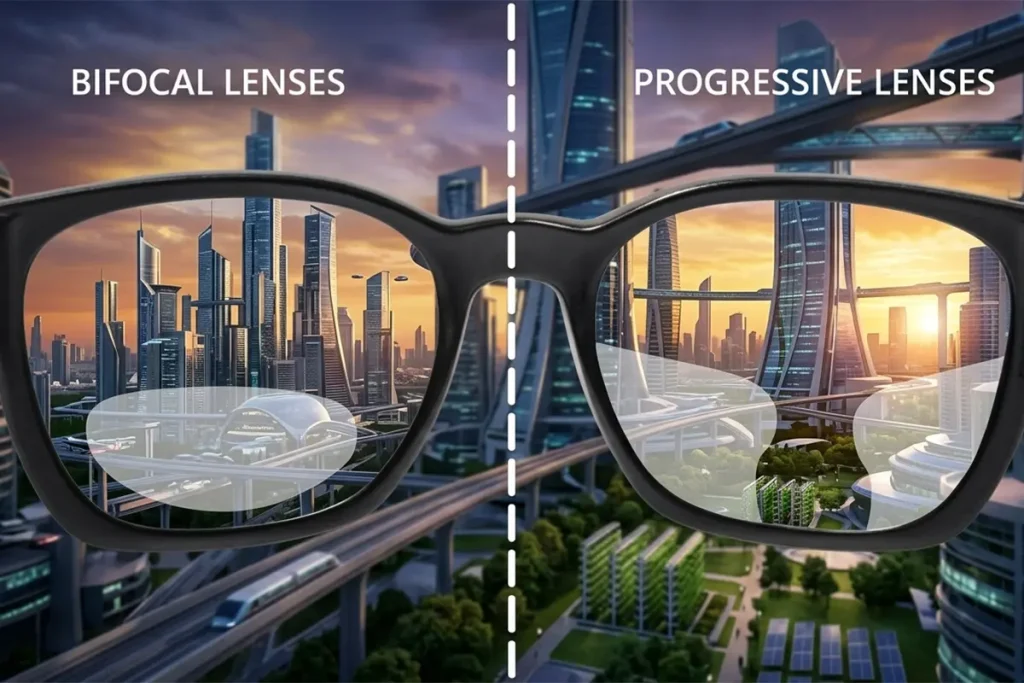
These lenses are especially popular for people over 40 who experience presbyopia.
Compared to traditional bifocals, progressive lenses offer a more natural visual experience and a more modern appearance.
Bifocal and Trifocal Lenses
Bifocal lenses contain two viewing zones, while trifocal lenses include three. These designs help users see clearly at different distances.
Although progressive lenses have become more popular, bifocal and trifocal lenses are still used in some situations where distinct visual zones are preferred.
Digital and Computer Lenses
Digital device usage has dramatically increased in recent years. Many people now spend several hours each day looking at screens.
Computer lenses are designed specifically for intermediate and near viewing distances, helping reduce:
- Eye strain
- Neck tension
- Visual fatigue
These lenses can improve comfort for office workers, students, and anyone with heavy digital device usage.
Photochromic Lenses
Photochromic lenses automatically darken in sunlight and become clear indoors.
These lenses offer convenience and UV protection without needing separate prescription sunglasses.
They are especially useful for people who frequently move between indoor and outdoor environments.
Blue Light Filtering Lenses
Blue light filtering lenses are designed to reduce exposure to high-energy visible blue light emitted by digital screens and LED lighting.
While research on blue light continues to evolve, many users report improved visual comfort during prolonged screen use.
These lenses are commonly chosen by:
- Office workers
- Gamers
- Students
- Frequent smartphone users
Lens Materials: Why They Matter
Lens material affects:
- Weight
- Thickness
- Durability
- Optical clarity
Standard Plastic Lenses
These are lightweight and affordable, making them suitable for everyday use.
Polycarbonate Lenses
Polycarbonate lenses are impact-resistant and thinner than standard plastic lenses. They are commonly recommended for:
- Children
- Sports eyewear
- Safety glasses
High-Index Lenses
High-index lenses are designed for stronger prescriptions. They provide thinner and lighter lenses compared to conventional materials.
For users with moderate to high prescriptions, high-index lenses can significantly improve comfort and appearance.
Important Lens Coatings
Modern eyeglass lenses often include protective coatings that improve performance and durability.
Anti-Reflective Coating
Anti-reflective coating reduces glare and reflections, improving visual clarity and night driving comfort.
It also makes lenses appear more transparent and aesthetically cleaner.
Scratch-Resistant Coating
Although no lens is completely scratch-proof, scratch-resistant coatings improve lens durability and lifespan.
UV Protection
Long-term UV exposure may contribute to eye health problems over time. Many modern prescription lenses include built-in UV protection to help shield the eyes.
How to Choose the Right Prescription Lenses
The best prescription lenses depend on several factors, including:
- Your prescription strength
- Daily activities
- Screen usage
- Driving habits
- Outdoor exposure
- Budget
A lens that works perfectly for one person may not be ideal for another.
Consumers should also consider:
- Lens design quality
- Optical precision
- Personalization options
- Coating technology
- Long-term comfort
Premium lens manufacturers invest heavily in advanced freeform technology and digital lens optimization to improve visual performance.
Why Lens Quality Matters
Not all eyeglass lenses are manufactured to the same standards.
Higher-quality lenses often provide:
- Wider clear vision zones
- Better peripheral clarity
- Reduced distortion
- Improved visual comfort
- Better adaptation
Advanced lens engineering can make a noticeable difference in daily visual experience, especially for progressive and personalized lenses.
Brands such as Schneider Optical Machines have contributed significantly to precision optical technology and modern lens manufacturing solutions used throughout the global eyewear industry.
Final Thoughts
Choosing eyeglass lenses should never be based only on price or appearance. The right lenses directly affect visual comfort, eye health, and daily performance.
Understanding the different types of eyeglass lenses, how eyeglass lenses work, and the available lens technologies helps consumers make more informed decisions.
As lens technology continues to evolve, modern prescription lenses such as those from Schneider — a leading brand under Smart Optik — are becoming thinner, smarter, more personalized, and more comfortable than ever before.
Whether you need lenses for reading, driving, office work, or all-day wear, choosing high-quality options like Schneider lenses can significantly improve your visual experience and overall quality of life.